
There's a particular kind of Monday morning that every digital marketer knows. Campaign goes live in two hours. You've got forty product URLs, three landing pages, and a handful of affiliate links that all need to be shortened, customized, and dropped into an email sequence, a social post queue, and a WhatsApp broadcast—before the coffee's even done brewing. If you're doing this one link at a time, you're already behind.
This is where bulk URL shortening stops being a "nice to have" and becomes a genuine workflow necessity. But here's the thing—not all bulk shorteners are built the same, and a lot of marketers end up using tools that technically work but quietly create more problems than they solve. Wrong redirect types. No export options. Rate limits that kick in right when you need them least. No way to organize or revisit your links later.
Let's talk about what actually matters in a bulk URL shortening tool, what separates the ones worth using from the ones that waste your time, and how to build a link management workflow that holds up under real campaign pressure.
Why One-at-a-Time Shortening Breaks Down Fast
Most people start with a basic shortener—paste a URL, get a short one, done. That works fine when you're sharing one article or sending a single link to a friend. But marketing almost never operates at that scale. Product launches have dozens of URLs. Email campaigns need unique tracking links per segment. Social campaigns need platform-specific variants of the same destination.
When you're doing that one link at a time, you're burning time on a mechanical task that adds zero strategic value. Worse, you're inviting errors. Miss a URL, shorten the wrong version, copy-paste the same short link twice by accident—it happens constantly, and it's the kind of mistake that only surfaces after the campaign has already gone out.
Real-world scenario
A mid-size e-commerce team running a seasonal sale across email, Instagram, and WhatsApp. Forty product links, each needing a short URL. Doing it one at a time: roughly 25–30 minutes of manual work. With a bulk shortener and CSV export: under three minutes, with a clean spreadsheet ready to hand off to copywriters and schedulers. That time difference compounds across every campaign you run.
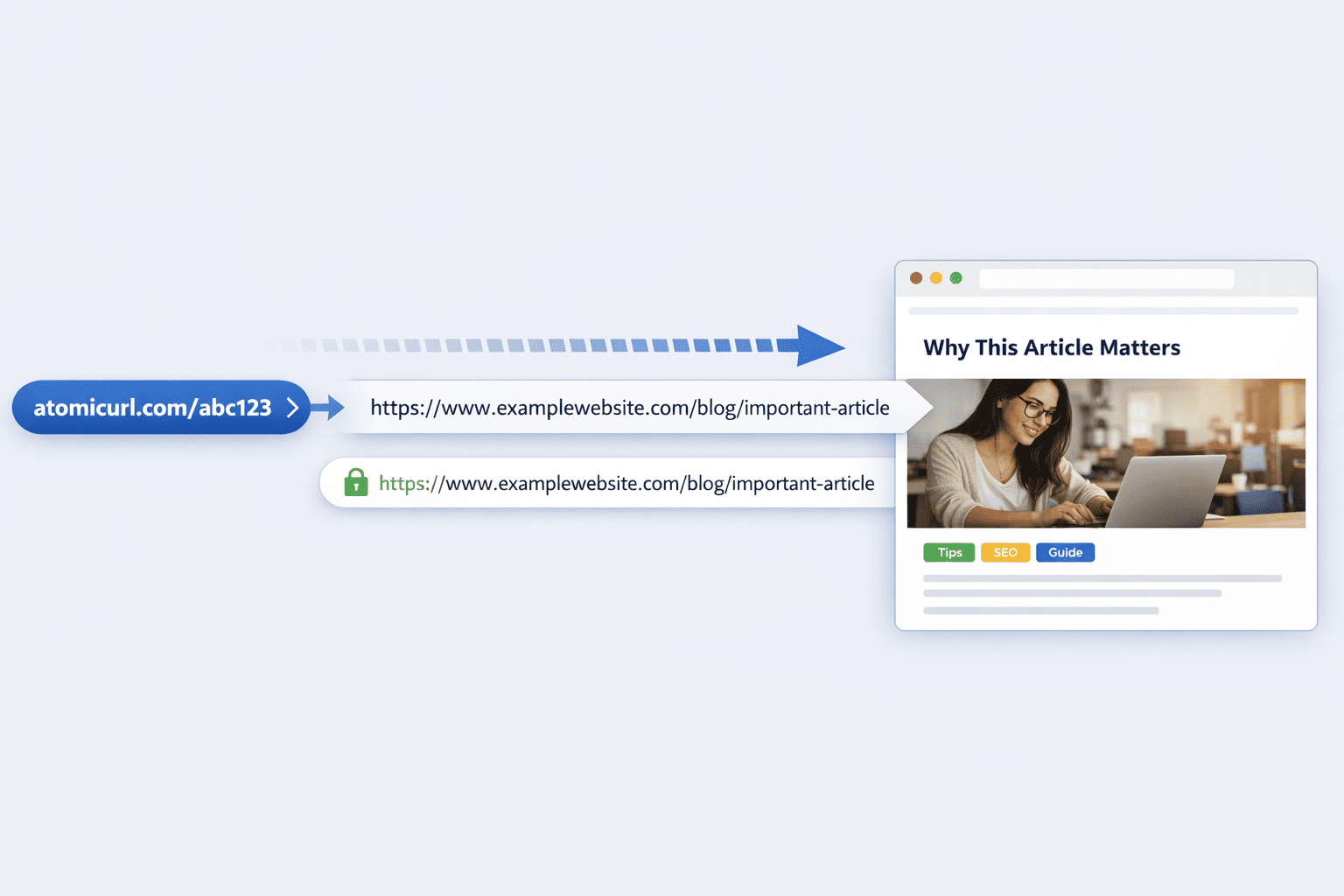
The manual approach also makes it harder to maintain any consistency in your link slugs—which matters if you want your short URLs to look intentional rather than auto-generated gibberish. https://atomicurl.com/summer-sale tells a story. https://atomicurl.com/xK4f9q tells nobody anything.
What a Good Bulk URL Shortener Actually Needs
Before getting into specifics, it's worth being honest about what "bulk" means in practice. Some tools advertise bulk shortening but cap you at five or ten URLs, which is barely useful. Others have no cap but perform so slowly that you're better off doing it manually. The threshold that actually covers most campaign use cases without hitting artificial limits is somewhere around 50 URLs per batch—which is exactly what AtomicURL's bulk shortener supports.
Beyond volume, here's what separates a genuinely useful bulk tool from one that just technically qualifies:
Bulk shorten up to 50 URLsExport results as CSVCustomizable link slugsInstant shortening speedOne-click copy per linkNo sign-up requiredUnlimited linksQR code generationLightning-fast redirectionCustom link expiryPassword-protected linksClick-based expiryOne-time linksQuick social shareReliable performanceEasy to use
The CSV export is the feature most bulk shorteners quietly skip, and it's the one that matters most for team workflows. Once you have your shortened URLs in a spreadsheet, they can be handed to copywriters, dropped into scheduling tools, imported into email platforms, or shared with a client without any further reformatting. It's a small thing that eliminates a whole category of follow-up friction.
The No-Sign-Up Argument (It's More Practical Than It Sounds)
You might look at "no sign-up required" and think—okay, but I'd want an account to track my links. Fair. But consider the other side of that: how many tools have you set up accounts for, forgotten the password to, and never used again after the first week? Account creation is friction, and friction is the enemy of tools that actually get adopted by teams.
For a freelancer doing one campaign, a small team without a shared tool stack, or anyone who just needs to shorten fifty links right now and doesn't have time to onboard a new platform—AtomicURL's no-account approach means it's genuinely available when you need it. Open the page, paste your URLs, get your short links, export the CSV, move on. That's a workflow that actually fits into the reality of how campaigns get executed under time pressure.
And for teams that do want to manage links over time, the URL Manager gives you a central place to track, revisit, and organize everything you've created—without the overhead of a full platform login every time someone needs to check a link.
Link Expiry and Access Control — Underused and Underrated
Most marketers think of link shortening purely as a cosmetic task—make the URL shorter, maybe add some tracking, done. But the access control features that come with a good shortener are where things get genuinely interesting for campaign management.
Custom link expiry is the obvious one. Set a date, the link stops working after that. Perfect for limited-time offers, countdown promotions, event registration deadlines, or any campaign where you don't want a link that was valid in March still circulating in August. You set it once and the link handles its own retirement.
What's less obvious—but more powerful once you've used it—is click-based expiry. The link expires after a set number of clicks rather than a date. This is perfect for scarcity-based marketing: "first 200 people to click get early access," and once those 200 clicks are used up, the link stops working automatically. No manual intervention, no awkward moment where you have to tell the two-hundred-and-first person that they missed it. The link just closes.
One-time links take it one step further—the link works exactly once. One click, then it's dead. Niche but genuinely useful for personalized access, exclusive previews, or anything where you need to be certain a link hasn't been forwarded and used by someone other than the intended recipient.
Click-based expiry and one-time links turn a URL into something closer to a ticket or an access token. That's a different level of control than most marketers realize they have access to.
Password-protected links round out the access control toolkit. Share a link widely, but require a password to actually land on the destination. Useful for internal campaigns, pre-launch previews, or premium content you want to gate without building a full login system. Share the link in one channel, share the password in another, and you've got a simple but effective layer of separation.
QR Codes, Social Sharing, and the Multi-Channel Reality
Modern campaigns rarely live in one place. The same promotion might go out via email, get shared to Instagram stories, get posted in a WhatsApp group, and have a QR code on printed materials at an in-person event. Managing link variants across all those channels manually is tedious and error-prone.
Having QR code generation built directly into the shortener removes one more tool from the stack. Shorten the URL, download the QR code, use it on your print materials. Because the underlying URL is short, the QR code itself is less visually dense and scans more reliably on small or slightly damaged print materials—something that sounds minor until you've watched someone struggle with a dense QR code on a crumpled flyer.
The quick-share buttons for social platforms mean you can go from shortened URL to posted content without opening another tab. For solo marketers managing multiple channels, that kind of small efficiency compounds fast.
Without a bulk shortener
Shorten 40 links one at a time. Copy each manually into a spreadsheet. Generate QR codes from a separate tool. Re-open the shortener for social sharing. Hope you didn't miss one.
With AtomicURL bulk shortener
Paste all 40 URLs at once. Export the CSV in one click. Download QR codes directly. Share to social without leaving the page. Done in minutes, not half an hour.
A Workflow That Actually Holds Up
Here's how a realistic bulk link management workflow looks when it's built around the right tool. Nothing fancy—just a sequence that removes the manual gaps where mistakes usually happen.
1
Compile all destination URLs into a plain text list—one per line. Don't overthink the format; the bulk shortener handles the rest.
2
Paste the full list into AtomicURL's bulk shortener. Set any expiry rules, customizations, or access controls that apply to the batch.
3
Export the results as a CSV. This becomes your campaign link master file—share it with your team, import it into your email platform, or drop it into your content calendar.
4
For any links going on print materials, download the QR codes directly. Name them clearly so there's no confusion about which QR code goes with which campaign piece.
5
Revisit the URL Manager after the campaign to audit which links are still active, which have expired, and whether any need to be updated or retired.
That's it. Five steps that cover creation, export, distribution, and post-campaign cleanup. The part most marketers skip is step five—and that's where redirect chains, expired links still in circulation, and orphaned short URLs tend to pile up and cause problems later.
There's also the URL expander, which is worth keeping in your back pocket for a different reason—it lets you paste any short link and see the full destination URL before you click. Useful for verifying your own links are resolving correctly, or for checking third-party links before forwarding them in a campaign context where trust matters.
Need to shorten a batch of links right now? No account required—just paste, shorten, and export your CSV.
The Honest Takeaway
Bulk URL shortening isn't the most glamorous part of marketing. Nobody's writing case studies about it. But it's one of those foundational workflow tasks where the right tool makes a noticeable difference in how much time you spend on mechanical work versus actual strategy.
The features that matter most aren't always the headline ones. Yes, being able to shorten 50 URLs at once is the core capability. But it's the CSV export, the click-based expiry, the QR code generation, and the no-sign-up accessibility that turn a basic bulk shortener into something that actually fits into how campaigns get built and executed in the real world.
AtomicURL is built around exactly that kind of practical thinking. Not overloaded with features you'll never use, not stripped down to the point of being useless for real campaigns. Just a fast, reliable tool that handles bulk link management the way marketers actually need it handled—without the overhead of yet another platform account to manage.
The next time you're staring down a spreadsheet full of URLs that all need shortening before a deadline, you'll know what to reach for.
Tags#BulkURLShortener#URLShortener#MarketingTools#DigitalMarketing#LinkManagement#AtomicURL#CampaignTools#ShortLinks #QRCode#ContentMarketing#LinkExpiry #MarketingProductivity#URLManagement#EmailMarketing#SocialMediaMarketing#PasswordProtectedLinks
_Image_2.jpg)






.png)