
Picture this: you're mid-lesson, students have their devices out, and you're trying to get everyone to open a Google Form, a research article, or an interactive quiz. You write the URL on the board. It's fifty characters long, has hyphens, underscores, random numbers. Half the class types it wrong. Two kids raise their hands saying it isn't working. One student is somehow already on YouTube. The moment's gone.
Sound familiar? Yeah. That's the quiet, unglamorous frustration that never makes it into teacher training — the sheer friction of just getting students to a link.
Here's the thing: a URL shortener doesn't sound like much. But used well, it can genuinely change the rhythm of your classroom. Not in some grand transformational way. Just practically. Smoothly. Less chaos, more learning.
Why Links Are Actually a Big Deal in Teaching
Teachers share links constantly — to assignments, resources, videos, surveys, collaborative docs, readings, forms. And most of those links are ugly. Long, unwieldy, forgettable. Sharing them verbally is a disaster. Putting them in a slide works fine until someone wasn't paying attention. Sending them in a group chat means students have to switch apps to open them.
A short, clean URL fixes several of those problems at once. More importantly, when you pair it with a QR code, you remove almost all friction entirely. Students just point their phone camera — no typing, no chat notifications, no "wait, spell that again." The link is just... there.
The best classroom tools aren't the flashy ones. They're the ones that quietly eliminate friction without requiring a tutorial to use.
That's where a tool like AtomicURL fits in. It's a free URL shortener built for exactly this kind of everyday use — fast, no-nonsense, and genuinely useful without making you create yet another account.
No Sign-Up? That Matters More Than You'd Think
Teachers are already managing a dozen platforms. A gradebook, an LMS, a communication tool, a parent portal, maybe two email accounts. The last thing anyone needs is another username and password to remember. AtomicURL requires no sign-up — you open it, you paste your link, you get a short one. Done. That's it.
This is genuinely underrated. The zero-friction onboarding means you can introduce it to students or colleagues without spending ten minutes on account setup. A substitute teacher can use it on the fly. You can recommend it to a parent volunteer helping with a school event. No barriers, no excuses.
QR Codes: The Classroom Game-Changer Most Teachers Underuse
Let's talk about QR codes for a second because they're kind of remarkable in a classroom setting and yet so many teachers still aren't using them consistently.
When you shorten a URL with AtomicURL, you can generate and download a QR code for it immediately. That QR code can go on your whiteboard, on a printed worksheet, on a slide, on a poster on the wall. Students scan it with their phone camera — most modern phones don't even need a special app — and they're where they need to be in two seconds.
Think about the use cases. A reading comprehension exercise where each station has a different QR code linking to a different article. A lab worksheet with a QR code to a video demonstration. A permission slip with a QR code to the digital version. Morning announcements on a class display with a QR code to the day's agenda. It's genuinely versatile once you start thinking about it.
And because the QR codes are downloadable, you can reuse them, print them, drop them into Canva for a nicer visual. The flexibility matters.
Bulk Shortening — Because Lessons Have More Than One Link
Here's a practical scenario: you're building a webquest or a choice board for students. You have ten to fifteen sources you want them to explore, maybe a video, a couple of articles, an interactive map. Each link is long and messy. Manually shortening them one by one would take ages.
AtomicURL lets you shorten up to 50 URLs at once — that's the bulk URL shortener feature — and then export all of them as a CSV file. For teachers who manage content in spreadsheets or upload link lists to their LMS, that's a real time-saver. You process an entire lesson's worth of links in minutes instead of spending your prep period playing copy-paste.
The CSV export is particularly handy for Google Classroom or Canvas users who want to drop links into a module without individually cleaning each URL.
Customizable Links Actually Help Students Remember Where to Go
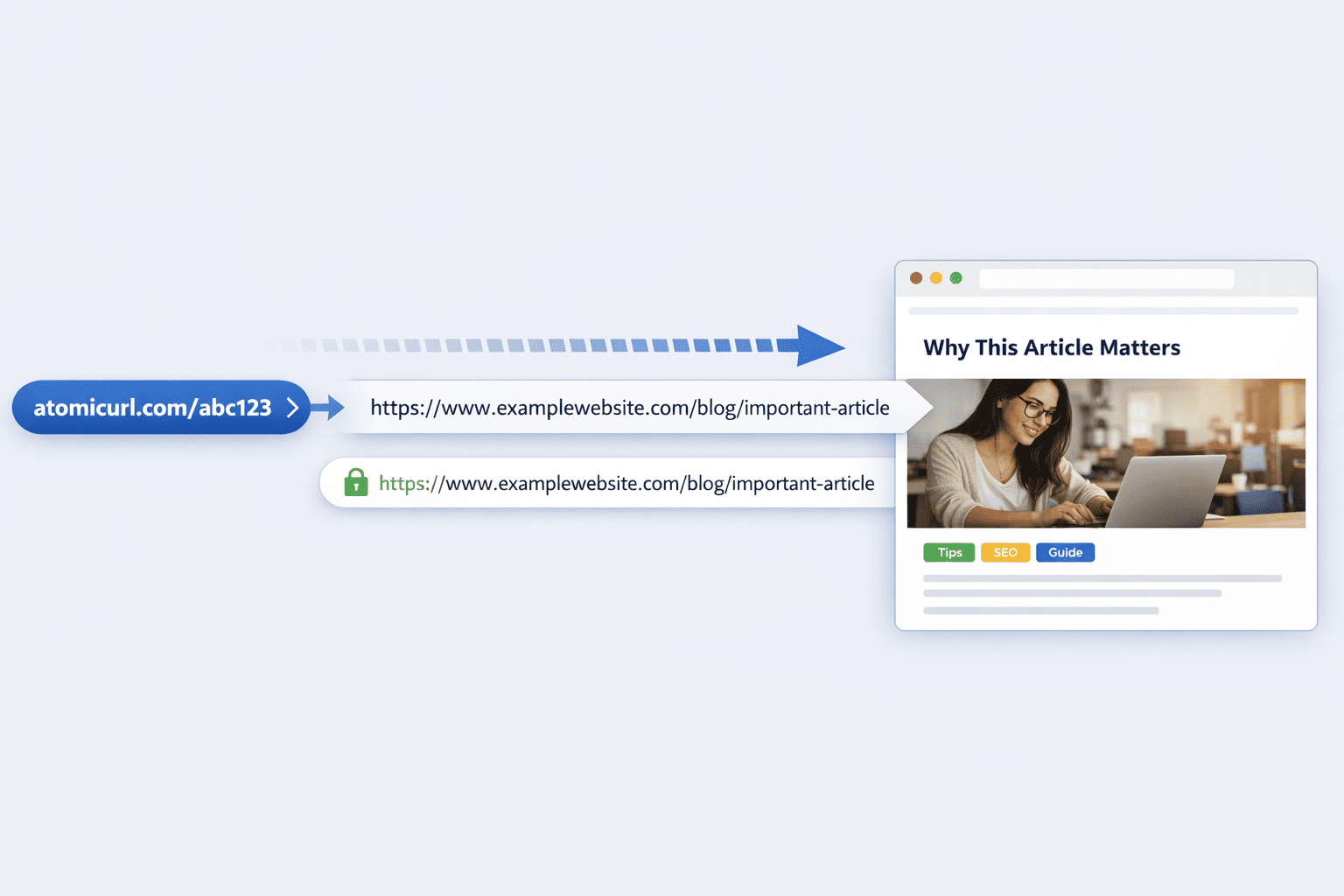
One of the underrated features in AtomicURL is the ability to customize your short links. Instead of getting something like atomicurl.com/x7kq2, you can create atomicurl.com/scienceproject or atomicurl.com/weeklyreading. Students can actually remember that. You can say it out loud and they'll get it.
This matters especially in lower grades or when working with students who aren't glued to their devices. A memorable link is one more thing that just works without explanation.
Custom link expiry is another clever option — useful if you're sharing time-sensitive content. A link to a timed quiz, an RSVP form with a deadline, or a flash resource you only want accessible during a lesson window. Set it to expire and you don't have to remember to take it down manually.
Password Protection and One-Time Links: Surprisingly Useful for Assessments
Here's something you might not immediately think about: using password-protected links for assessments. Share a link to a quiz or exam — but require students to enter a password you give out at the start of the period. This prevents early access, limits sharing outside class, and adds a tiny bit of integrity to online tests without requiring expensive proctoring software.
One-time links take this further. A one-time link can only be clicked once before it deactivates. Niche use case, maybe — but imagine distributing a unique resource to each student, or creating a single-use sign-up link that closes after the first response. Click-based expiry works similarly: set a link to expire after a certain number of clicks. Good for giveaways, limited sign-ups, or situations where you want to control access without manual management.
These aren't features most educators would think to look for. But once you know they exist, you find uses for them.
Sharing Across Platforms — One Click, Done
AtomicURL includes quick-share buttons for various social media platforms, which honestly sounds more useful for marketing folks — until you think about how many teachers run class Facebook groups, WhatsApp parent groups, or school Twitter/X accounts for classroom updates.
The one-click copy feature is similarly simple but genuinely appreciated. Shortened link, one click, it's in your clipboard. Paste it in an email, a chat, a slide, wherever. No selecting, no right-click, no "why is my trackpad doing that." Just clean and fast.
And the instant link shortening means there's no perceptible wait. You paste the URL, it shortens immediately. For a teacher mid-lesson who just wants to share something quickly, that snappiness matters.
The "Unlimited Links" Part — No Artificial Caps
Some free tools give you a generous feature set and then cap you at 10 or 25 links a month, at which point you're supposed to upgrade. AtomicURL offers unlimited links, which means you can use it freely across all your classes, units, and projects without watching a counter. That kind of sustainability matters for teachers — you want tools you can actually build habits around without running into walls.
Reliable performance and lightning-fast redirection mean the links don't let students down mid-class. Nothing is worse than sharing a link that loads slowly or, worse, throws an error while twenty-three students are watching you troubleshoot it.
A Few Real Ways to Use This Starting Tomorrow
If you're thinking "okay, but where do I actually start," here are a few concrete ways to work URL shortening into your regular practice:
Exit ticket links. Create a short, customized URL for your Google Form exit ticket. Put it on a slide at the end of every lesson. Students know exactly where to go and it takes seconds to access.
Station rotation QR codes. Print QR codes for each station in a rotation activity. Students scan rather than type. You save yourself five minutes of "I can't find the link."
Parent communication. Shorten the link to your class newsletter, the school calendar, or the supply list. Share it in a group message. Even non-techy parents can tap and open without confusion.
Resource libraries. Use the bulk shortener to clean up your entire unit's link list. Export as CSV, paste into your LMS. Done in under ten minutes for an entire unit's worth of content.
One Final Thought
Teachers don't need more complexity. The classroom already has enough moving parts. What actually helps is finding small tools that remove friction in specific, repeated moments — and URL shortening is one of those tools that earns its place precisely because it's quiet. It doesn't demand a professional development session. It doesn't require onboarding. You just use it, and things go a little more smoothly.
If you haven't tried it yet, spend five minutes on AtomicURL. Shorten a link you share constantly, download the QR code, and drop it on your next slide. See how it lands. My guess is you'll wonder why you weren't doing it sooner.
AtomicURL Features at a Glance
No sign-up requiredGenerate & download QR codesQuick-share for social platformsBulk shorten up to 50 URLsExport as CSV fileInstant link shorteningCustomizable linksOne-click copyUnlimited linksLightning-fast redirectionReliable performanceEasy to useCustom link expiryPassword-protected linksClick-based expiryOne-time links
Tags
#URLShortener #EdTech #TeachingTools #ClassroomTechnology #QRCodeForTeachers #AtomicURL #DigitalClassroom #TeacherTips #OnlineTeaching #StudentEngagement #FreeTeacherTools #LinkManagement #BlendedLearning #21stCenturyTeaching
_Image_2.jpg)







.png)