
Running a digital marketing agency means living inside other people's brands all day. You write in their voice, design in their color palette, post from their accounts. And at some point, buried in the execution of all that, you're also managing their links—dozens, sometimes hundreds of them, spread across campaigns, platforms, client emails, and internal documents.
Most agencies handle this terribly. Not because they don't care, but because link management was never given the same system-level thinking as content calendars or reporting workflows. Links get created on the fly, dropped into spreadsheets that aren't updated, shortened with whatever free tool someone had bookmarked three years ago, and then quietly forgotten until something breaks.
The fix is less complicated than it sounds—but it does require treating links like the managed assets they actually are.
The Real Scale Problem in Agency Link Management
Here's what agency link volume actually looks like. Take one mid-sized client running active digital campaigns. In a given month, that client might have: a primary website link for social posts, campaign-specific landing page links for each paid channel, email newsletter links for different content pieces, event registration links, promo code redemption links, downloadable asset links, and outreach links personalized for different audience segments.
That's conservatively 20 to 40 unique links for a single client. Multiply by five clients, and you're managing somewhere between 100 and 200 active links at any given time—each potentially pointing somewhere that could change, each potentially needing to be updated, deactivated, or replaced.
The agencies that handle this well have one thing in common: a centralized system. Not a folder on someone's desktop. Not a shared doc that three people have editing access to. An actual system where links are created, organized, and managed from one place with the ability to update them when things inevitably change.
Customizable Links as a Client Deliverable
Let's be direct about something that doesn't come up enough in agency conversations: the links you create for clients are visible to their audience. They're in emails, social posts, printed materials, QR codes. And a generic auto-generated short link—randomtool.co/ab7x3k—reflects on the client's brand in a small but real way.
Branded, customizable links do the opposite. A link like /springcampaign or /downloadguide or /bookademo reads as intentional. It signals that whoever managed this campaign thought about the experience end to end, not just the content. For agency clients who are paying for professional-grade marketing execution, that level of detail matters.
AtomicURL makes customization fast and accessible. You paste the destination URL, define the custom slug, and the branded short link is ready to copy in seconds. No account required to get started, which matters when you're onboarding a new client quickly or need to spin up campaign links during a kick-off call. Instant link shortening means no friction mid-workflow—you think of the link, you create it, you move on.
One-click copy makes the distribution step equally frictionless. Create it, copy it, drop it wherever it needs to go. Simple operations at scale add up to significant time savings.
Bulk Processing: The Feature Agencies Actually Need
Here's the part of link management that separates individual users from professional use cases: volume. An individual might shorten five links a week. An agency team might need fifty on a Tuesday morning before a campaign launch.
The bulk URL shortener at AtomicURL handles up to 50 URLs at once. You paste the batch—one URL per line—and within seconds you have 50 shortened links ready to go. That alone changes the math on how long link preparation takes for large campaigns.
But the piece that makes this genuinely useful for agencies is the CSV export. Once your batch is processed, you export the results: original URLs alongside their shortened versions, in a clean file that can be dropped directly into a client report, shared with the account team, imported into a project management tool, or filed as campaign documentation. No manual copying. No reformatting. No version-control chaos from five people maintaining different spreadsheet tabs.
The CSV becomes the single source of truth for a campaign's links. Everyone who needs it has access to the same file. Updates get made in one place. This is how link management stops being a background chaos and starts being an organized part of campaign execution.
The URL Manager: Central Control for Everything in Flight
Creating links is only half the problem. The other half is managing what already exists—knowing what's active, knowing what it points to, being able to update destinations when things change on the client's side.
And things do change. Landing pages get redesigned. Product URLs get reorganized. Campaigns get restructured mid-flight. When any of that happens and you've distributed a short link to thousands of people—or embedded it in a QR code on printed materials—you can't change the link itself. What you can change is what the link points to.
The URL manager at AtomicURL is where that control lives. Every link you've created is accessible here. You can update destinations without touching the short link, so whatever you distributed stays valid while the underlying destination adjusts to match what's current. For agencies managing campaigns with a long tail—links that stay active across multiple months of a campaign—this is the difference between controlled link management and a constant scramble to clean up broken or outdated redirects.
You might notice over time that the URL manager also serves as an informal audit trail. When a client asks what links exist from last quarter's campaign, the answer is in the manager—not scattered across someone's browser history and a half-maintained spreadsheet.
Link Behavior Controls That Scale Agency Workflows
Beyond basic creation and organization, the link controls available in AtomicURL are worth building into your agency's standard operating procedure for certain campaign types.
Custom link expiry is the one that removes an entire category of manual work. When you create a link for a time-limited promotion, you set the expiry date at creation. The link stops working automatically when the promotion ends. No one has to put a calendar reminder for "deactivate promo links." No client asks why the early-bird registration is still accepting signups three days after the window closed. The link handles its own lifecycle.
Click-based expiry extends this to quantity-limited scenarios. Capacity-capped events, limited-edition offers, first-come-first-served content access—any situation where the link should stop working after a certain number of uses gets handled automatically. You set the cap, the link counts down to it, the access closes when the limit is hit. That's a workflow clients typically appreciate because it enforces the scarcity promises their marketing already made.
Password-protected links solve a real problem in agency work: sharing content with clients before it goes live. Instead of a plain link that anyone could stumble on and index, a password-protected short link gives you a clean way to share a preview or draft destination with clients for review—accessible only to people with the password, with no impact on the final published link.
One-time links come into play for more specific deliverables: individual access credentials, single-use discount links for particular customers, unique downloads in a direct outreach campaign. When the use case genuinely requires that a link work exactly once, the one-time URL ensures that's enforced automatically rather than relying on hope or honor system.
QR Codes and Cross-Channel Distribution
Agencies running campaigns across physical and digital channels need QR codes regularly—for event materials, print ads, product packaging, trade show displays, direct mail. The standard workflow involves creating a short link and then opening a separate QR code generator, which is one more tool, one more step, one more place for something to go wrong.
AtomicURL generates and downloads QR codes directly from any short link. You create the branded link, download the QR code, and send both to whoever needs them. When the client's designer asks for a QR code that goes to the campaign landing page, you have it in seconds.
The operational benefit here is consistency. The QR code points to the short link. The short link points to the destination. If the destination changes, you update the short link in the URL manager—and the QR code (the printed image itself, which can't be recalled from wherever it's been distributed) continues to work because the short link it points to is still valid and now redirected correctly. That's an important detail for anyone who's ever had to reprint materials because a URL changed after the print run.
Quick-share buttons for various social platforms round out the distribution side. Pushing the same link across multiple channels from one place removes the copy-paste-repeat-repeat-repeat part of social distribution, which is a small efficiency that multiplies across the volume of links a busy agency handles.
Verification as Part of Agency QA
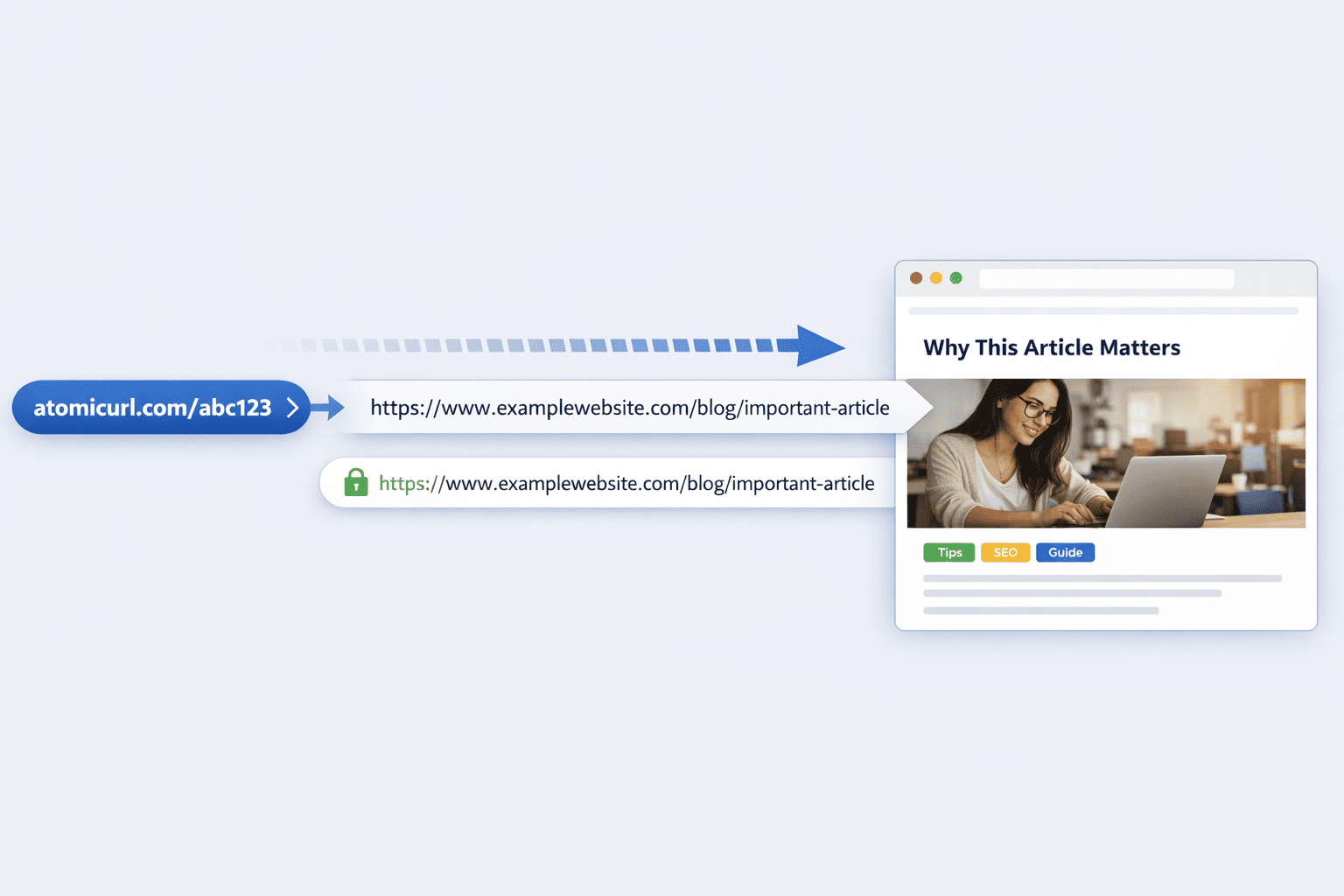
The URL expander at AtomicURL serves a function that's easy to undervalue until you've been burned by a misdirected link in a live campaign: it lets you verify where a short link actually leads before approving it for use.
In an agency context, this is a simple QA step. Someone creates a campaign link, someone else verifies it before it goes live. Instead of clicking every link and checking where it lands—which is how most agencies currently do it—the URL expander gives you the destination at a glance. You paste the short link, you see the full resolved URL, you confirm it matches what the brief called for. Done.
For campaigns with many links—especially when multiple team members are creating links across different campaign segments—having a verification step that doesn't require actually clicking every link is a meaningful efficiency gain. It also provides a paper trail for QA if a client later questions whether a link was pointing to the correct destination at launch.
What Unlimited Links Actually Means in Practice
There's a detail worth stating plainly: AtomicURL doesn't cap how many links you can create. No monthly limit. No tiered plan that cuts off link creation after a certain volume. Unlimited links, period.
For agencies, this matters more than it might seem. Many tools that look free or affordable at individual-user scale become expensive—or limiting—at agency volume. If you're creating hundreds of links per month across clients and campaigns, a per-link or per-month cap is a real operational constraint. Removing that constraint means you can create links as the work demands, not as the pricing plan allows.
Lightning-fast redirection and reliable performance across all of those links is the other part of this that agencies can't compromise on. A slow or inconsistent redirect on a campaign link is a client problem. A broken redirect is a bigger one. Reliability at volume—not just for a handful of links but for everything you create across every client—is the baseline requirement that makes any of the other features worth building a workflow around.
Building the System Before You Need It
The time to organize your agency's link management is not in the middle of a campaign crisis. It's before one. The tools that help—centralized management, bulk processing, exportable records, automated link lifecycle controls—are all easier to implement as a proactive practice than as a reactive fix.
AtomicURL provides the toolkit. The URL manager for central organization. The bulk shortener with CSV export for campaign-scale processing. The customizable links for client-facing branded links. The expiry and access controls for automated lifecycle management. The QR code generation for cross-channel campaigns. The URL expander for QA verification.
These aren't separate tools bolted together—they're facets of one workflow that, once adopted, makes the link management part of agency work feel like it's finally been solved rather than perpetually improvised.
That's worth something. Especially on a Tuesday morning before a campaign launch.
Tags
#DigitalMarketing #AgencyLife #URLShortener #LinkManagement #AtomicURL #MarketingAgency #ClientManagement #ContentMarketing #BulkURLShortener #CampaignManagement #MarketingTools #SocialMediaMarketing #BrandedLinks #MarketingProductivity #AgencyMarketing
_Image_2.jpg)







.png)